Enzymatic
Enzymatic#
For slightly more complex example,
SimBio contains compound reactions,
consisting of many single or compound reactions.
For instance,
from simbio.reactions.enzymatic
we can import a MichaelisMenten reaction,
which binds a substrate \(S\) to an enzyme \(E\)
creating an intermediate bound species \(E:S\),
before converting to the product \(P\) species:
It consists of a ReversibleSynthesis (\( S + E ↔ E:S\))
and a Dissociation (\(E:S → P + E\)) reaction.
In turn,
ReversibleSynthesis is also a compound reaction,
consisting of a Synthesis (\( S + E → E:S\))
and Dissociation (\( E:S → S + E\)) reactions.
import numpy as np

from simbio.components import EmptyCompartment, Species
from simbio.reactions.enzymatic import MichaelisMenten
from simbio.simulator import Simulator
When defining a model,
we do not need to explicitly create every species.
For instance,
the intermediate species ES,
is created inside the reaction
by assigning it to a number.
class Model(EmptyCompartment):
    enzyme: Species = 1
    subtrate: Species = 1
    product: Species = 0

    catalyze = MichaelisMenten(
        E=enzyme,
        S=subtrate,
        ES=0,  # "nameless" intermediate species
        P=product,
        forward_rate=1,
        reverse_rate=1,
        catalytic_rate=1,
    )
To simulate it,
we feed the model into Simulator,
and use the .run() method.
It will compile and integrate an ODE-based simulation,
returning a pandas.DataFrame with the result:
simulator = Simulator(Model)

t = np.linspace(0, 10, 100)
df = simulator.run(t)
df.head()
| enzyme | subtrate | catalyze.ES | product | |
|---|---|---|---|---|
| time | ||||
| 0.00000 | 1.000000 | 1.000000 | 0.000000 | 0.000000 |
| 0.10101 | 0.916804 | 0.912323 | 0.083196 | 0.004481 |
| 0.20202 | 0.860984 | 0.845092 | 0.139016 | 0.015891 |
| 0.30303 | 0.823633 | 0.791686 | 0.176367 | 0.031947 |
| 0.40404 | 0.798962 | 0.747866 | 0.201038 | 0.051096 |
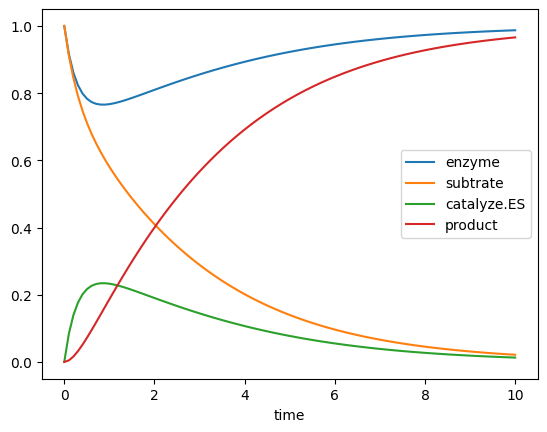
To visualize the time evolution,
we can use the DataFrame.plot method:
df.plot()
<AxesSubplot: xlabel='time'>